Seven-Case Declension in Real-Time
Czech's seven grammatical cases change the form of nouns, adjectives, and names throughout speech. "Jan Novák" becomes "Jana Nováka" (genitive), "Janu Novákovi" (dative), "s Janem Novákem" (instrumental). Interpreters must instantly recognize declined name forms and render them correctly in English — a challenge that trips up even bilingual speakers without formal training.
Legal Terminology & Rodné Číslo System
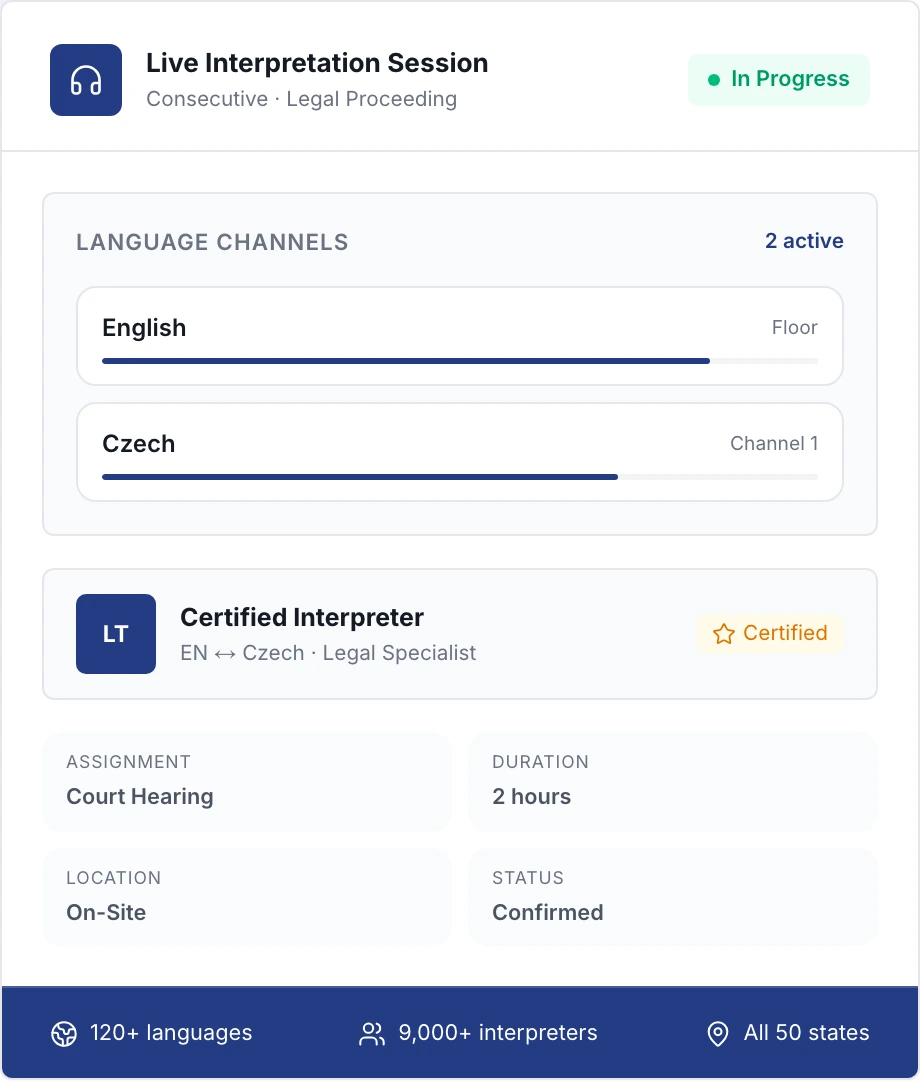
Czech legal proceedings reference the rodné číslo (birth number) — a unique 10-digit identifier encoding birth date and gender — along with Czech-specific legal concepts from the Občanský zákoník (Civil Code) and Trestní zákoník (Criminal Code). Our interpreters accurately convey terms like "příslušný soud" (competent court), "právní moc" (legal force/finality), and "usnesení" (resolution) to English-speaking judges and attorneys.
Medical Vocabulary & Patient Communication
Czech medical terminology combines Latin-origin clinical terms with colloquial patient language. Czech patients may say "mám tlak" (I have pressure — meaning hypertension) or "bolí mě v krku" (my throat hurts). Our interpreters bridge Czech patient expressions with precise medical English, ensuring accurate symptom reporting and informed consent across all specialties.
Czech-Slovak Mutual Intelligibility
Czech and Slovak are partially mutually intelligible, but they differ in vocabulary, grammar, and legal terminology. "Soud" (Czech court) vs. "súd" (Slovak court), "rodný list" (Czech birth certificate) vs. "rodný list" (same term, different format). Interpreters must never substitute Slovak for Czech, as this creates errors in legal contexts and offends Czech speakers.