Professional Interpretation Services

Professional Japanese Interpretation Services

Japanese interpreters for business negotiations, intellectual property proceedings, patent depositions, and immigration interviews. Our interpreters navigate keigo (honorific language) and specialized legal and corporate terminology fluently.

125+ million speakers 🇯🇵 日本語

Why Japanese Interpretation Requires Specialists

Japanese interpretation requires mastery of the keigo (敬語) honorific system — sonkeigo (尊敬語, respectful), kenjōgo (謙譲語, humble), and teineigo (丁寧語, polite) — which fundamentally shapes how meaning, social hierarchy, and intent are conveyed in legal, medical, and corporate settings. Our interpreters are recruited from Japan's legal and corporate sectors, with courtroom experience in EOIR immigration hearings, USCIS credible fear interviews, and intellectual property depositions involving Japanese multinationals such as Sony, Toyota, Honda, and Nintendo. They navigate the complexities of Japanese business culture — including 名刺 (meishi) exchange protocols, 根回し (nemawashi) consensus-building, and the indirect communication style that pervades Japanese corporate and legal discourse — ensuring nothing is lost when Japanese testimony or negotiation is rendered into English.

Whether you need an interpreter for a Japanese patent infringement deposition involving semiconductor technology, an immigration interview for an L-1 intracompany transferee from a Japanese automotive supplier, a psychiatry evaluation for a Japanese national navigating cultural stigma around mental health disclosure, or a high-level business negotiation where understanding 本音 (honne, true feelings) versus 建前 (tatemae, public facade) is critical, our Japanese interpretation team delivers linguistically precise, culturally fluent service across every professional setting.

Court-qualified Japanese interpreters available for legal proceedings, depositions, and hearings in all 50 states

Medically trained interpreters with CMI/CHI certification for healthcare settings

Rapid booking — confirmed within 24 hours, same-day and emergency requests available

On-site, video remote (VRI), and telephone (OPI) options — 24/7 availability

Where Our Japanese Interpreters Work

From USCIS field offices to hospital operating rooms, our Japanese interpreters are qualified for every professional setting where accurate communication is non-negotiable.

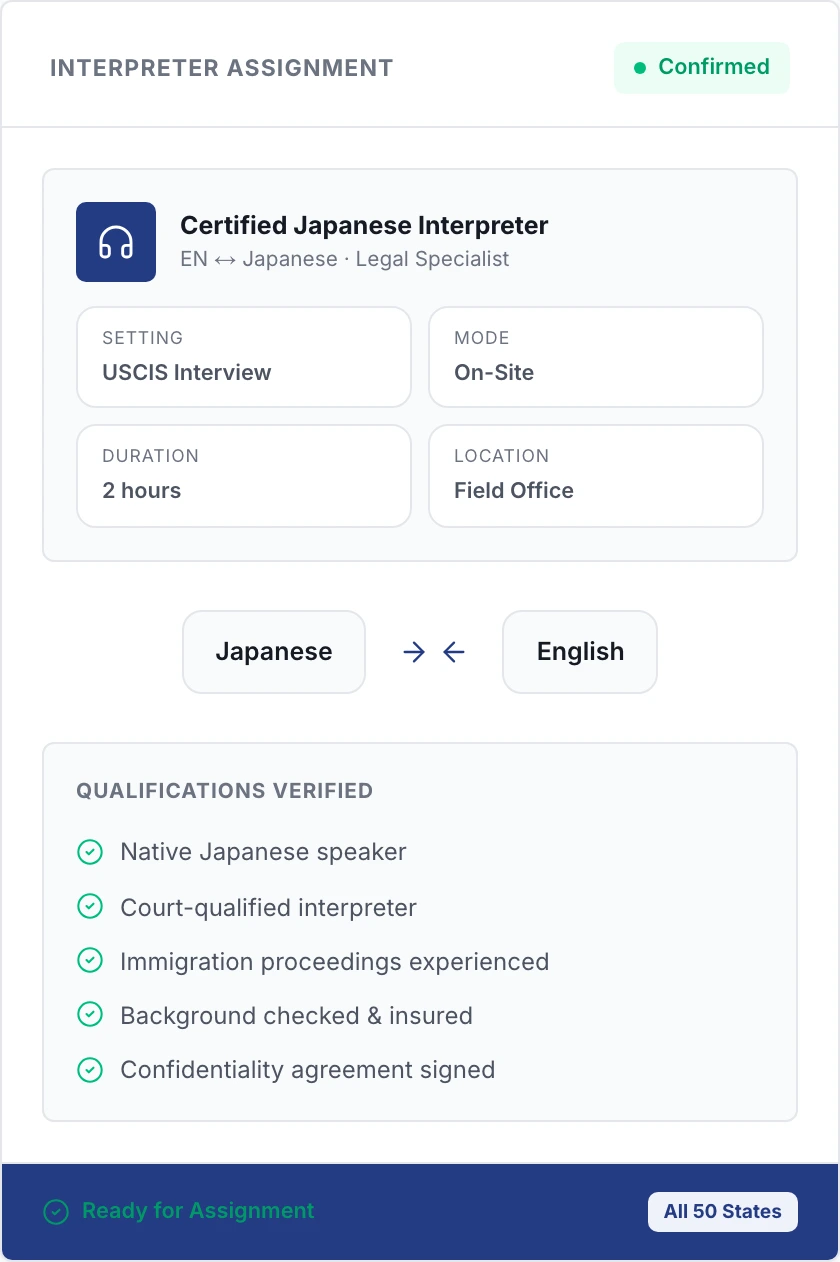
USCIS & Immigration Court

Immigration Specialist

Japanese immigration cases include intracompany L-1 transferees for Japanese multinationals, E-2 treaty investor visa holders, J-1 exchange visitors, and family-based petitions. Our interpreters handle USCIS naturalization interviews, adjustment of status proceedings, and consular processing support — understanding Japanese document terminology like 在留資格 (zairyū shikaku, residence status) and 帰化 (kika, naturalization).

Patent Litigation & IP Depositions

Court-Qualified

Court-qualified Japanese interpreters for intellectual property disputes involving Japanese companies. We handle patent infringement depositions, ITC Section 337 investigations, trade secret litigation, and licensing disputes — with deep vocabulary in semiconductor technology, automotive engineering, consumer electronics, and pharmaceutical chemistry.

Healthcare & Medical

HIPAA Compliant

HIPAA-compliant Japanese interpretation for hospitals, specialist clinics, and telehealth. Our medical interpreters understand Japanese cultural attitudes toward disclosure of terminal illness (告知/kokuchi), patient deference to physician authority, and the reluctance to express pain or discomfort directly — ensuring accurate communication in oncology, psychiatry, surgery consultations, and end-of-life care discussions.

Business & Corporate

Professional

Professional Japanese interpretation for corporate negotiations, board meetings, joint venture discussions, and trade delegations. Our interpreters navigate 根回し (nemawashi) consensus-building culture, understand the significance of 名刺 (meishi) business card exchange rituals, and accurately render Japanese corporate hierarchical language for M&A transactions, licensing agreements, and regulatory compliance discussions.

How You Connect with Your Japanese Interpreter

Choose the option that fits your setting — in-person for courtrooms and hospitals, video for remote hearings and telehealth, or phone for urgent and after-hours needs.

In-Person

On-Site Interpretation

A professional interpreter physically present at your location — courtroom, hospital, office, or event. Ideal for legal proceedings, medical consultations, and high-stakes meetings where face-to-face communication and body language are critical.

Court hearings & depositions
Medical appointments & surgeries
Business negotiations
Immigration interviews
Video

Video Remote (VRI)

Face-to-face interpretation via secure video platform. Combines visual cues with the convenience of remote access — perfect for healthcare, legal consultations, and hearings where an in-person interpreter isn't available on short notice.

Telehealth & virtual visits
Remote court hearings
Virtual depositions
IEP & school meetings
On-Demand

Telephone (OPI)

On-demand phone interpretation available 24/7, 365 days a year. Connect with a qualified interpreter in under 60 seconds — no appointment needed. Essential for emergency rooms, after-hours calls, 911 dispatch, and urgent legal consultations.

24/7 emergency access
ER & urgent care triage
After-hours legal calls
Government helplines

Japanese Interpretation for Immigration & Legal Proceedings

The Japanese community in the U.S. includes long-established Japanese-American families, corporate transferees at Japanese multinationals, students, and investors. Our interpreters handle the full spectrum of Japanese immigration proceedings — from L-1 intracompany transfers for Toyota or Honda executives to E-2 treaty investor applications for Japanese restaurant owners and naturalization interviews for longtime permanent residents.

USCIS & Immigration Court

The Japanese community in the U.S. includes long-established Japanese-American families, corporate transferees at Japanese multinationals, students, and investors. Our interpreters handle the full spectrum of Japanese immigration proceedings — from L-1 intracompany transfers for Toyota or Honda executives to E-2 treaty investor applications for Japanese restaurant owners and naturalization interviews for longtime permanent residents.

L-1 intracompany transferee interviews (Japanese multinationals)
E-2 treaty investor visa proceedings
J-1 exchange visitor & waiver hearings
USCIS naturalization & citizenship interviews
Adjustment of status & green card interviews
Family-based petition interviews (I-130)
Consular processing support (Tokyo, Osaka, Naha)
TN visa & specialty occupation consultations

Courts, Depositions & Trials

Our Japanese interpreters work in federal and state courts handling patent litigation involving Japanese technology companies, commercial disputes over Japanese supply chain contracts, family law matters involving binational Japanese-American couples, and criminal cases requiring interpretation of Japanese police documents (供述調書/kyōjutsu chōsho) and court records (裁判所/saibansho).

Patent infringement depositions (semiconductor, automotive, pharma)
ITC Section 337 investigations involving Japanese respondents
Family court: international divorce, custody (Hague Convention cases)
Commercial arbitration & licensing disputes
Attorney-client consultations (privileged)
Criminal defense involving Japanese nationals
Real estate transactions & joint venture agreements
Employment disputes & workplace harassment cases

Healthcare & Medical Interpretation

Certified Interpreters

Japanese patients in the U.S. — particularly elderly first-generation immigrants and corporate transferees' family members — often navigate healthcare with deep cultural norms around illness disclosure, stoic pain expression, and deference to medical authority. Our interpreters bridge these cultural gaps, ensuring that a patient's indirect expressions like "少し気になります" (I'm a little concerned) are conveyed with their full clinical significance.

Oncology consultations & cancer diagnosis disclosure (告知/kokuchi)
Psychiatry & mental health evaluations (cultural stigma navigation)
Surgical pre-op counseling & informed consent
Cardiology & internal medicine consultations
OB/GYN & prenatal care for Japanese mothers
Pediatric appointments & developmental assessments
Geriatric care & end-of-life discussions
Discharge planning & medication counseling (漢方/kampō herbal medicine considerations)

Why Japanese Interpretation Requires Expertise

Interpreting Japanese in high-stakes settings demands more than bilingual fluency — it requires specialized training, cultural competence, and domain expertise.

01

Keigo Honorific System

Japanese has three distinct levels of honorific speech — sonkeigo (尊敬語), kenjōgo (謙譲語), and teineigo (丁寧語) — that encode social hierarchy, deference, and formality. Legal testimony and courtroom proceedings demand the highest register; interpreters must instantly calibrate between these levels when rendering Japanese speech into flat English, preserving the speaker's intended level of respect and self-positioning.

02

Indirect Communication & Implication

Japanese speakers frequently convey meaning through implication, ellipsis, and context rather than direct statement. Phrases like "ちょっと難しいですね" (it's a little difficult) often mean "no" in practice. Interpreters must accurately convey the intended meaning — not just the literal words — especially in legal proceedings where ambiguity can affect case outcomes.

03

Technical & IP Vocabulary

Japan's major industries — automotive (Toyota, Honda, Nissan), electronics (Sony, Panasonic, Toshiba), gaming (Nintendo, Sega), and pharmaceuticals (Takeda, Astellas) — generate enormous IP litigation and patent deposition volume. Our interpreters handle specialized technical vocabulary covering semiconductor fabrication, automotive engineering, pharmaceutical compounds (特許/tokkyo = patent, 侵害/shingai = infringement), and software architecture.

04

Simultaneous Script Processing

Japanese uses three writing systems simultaneously — Kanji (漢字), Hiragana (ひらがな), and Katakana (カタカナ) — and interpreters must process documents, exhibits, and written testimony that freely mix all three scripts. Legal documents use formal Kanji compounds (供述調書/kyōjutsu chōsho = statement of confession) that differ substantially from spoken Japanese.
How to Book a Japanese Interpreter

Our streamlined process gets you a qualified, vetted Japanese interpreter — on-site or remote — with confirmation in as little as 24 hours.

Step 01

Order an Interpreter

Tell us the language, date, time, location (or remote), setting type (legal, medical, business), and any specialization requirements. Submit via our portal, email, or phone.

Step 02

Interpreter Matching

We match you with a qualified interpreter based on language pair, dialect, subject-matter expertise, certifications, and your specific setting. Court-qualified and medically certified interpreters are prioritized for legal and healthcare assignments.

Step 03

Confirmation & Prep

Receive confirmation with your interpreter's credentials and assignment details within 24 hours. For complex cases, your interpreter reviews relevant materials in advance to ensure accuracy during the session.

Step 04

Interpreter Joins Your Session

Your interpreter arrives on-site or connects remotely at the scheduled time — fully prepared, professionally dressed, and bound by strict confidentiality agreements. Post-session reports available upon request.

Industries We Serve with Japanese Interpretation

Our Japanese interpreters bring specialized knowledge to every industry, ensuring accurate terminology and regulatory compliance.

Legal & Immigration

Court filings, immigration petitions, contracts, depositions, and legal correspondence.

Healthcare & Medical

Medical records, clinical trial documents, patient communications, and insurance forms.

Government & Public Sector

Federal, state, and local government documents, public notices, and regulatory filings.

Financial & Banking

Financial statements, audit reports, banking documents, and compliance materials.

Education & Academic

Transcripts, diplomas, research papers, and credential evaluation documents.

Corporate & Business

Contracts, presentations, marketing collateral, manuals, and corporate communications.

Find Japanese Interpreters by State

Our network of Japanese interpreters spans the entire United States. Select your state to find qualified professionals near you, or request remote services from anywhere.