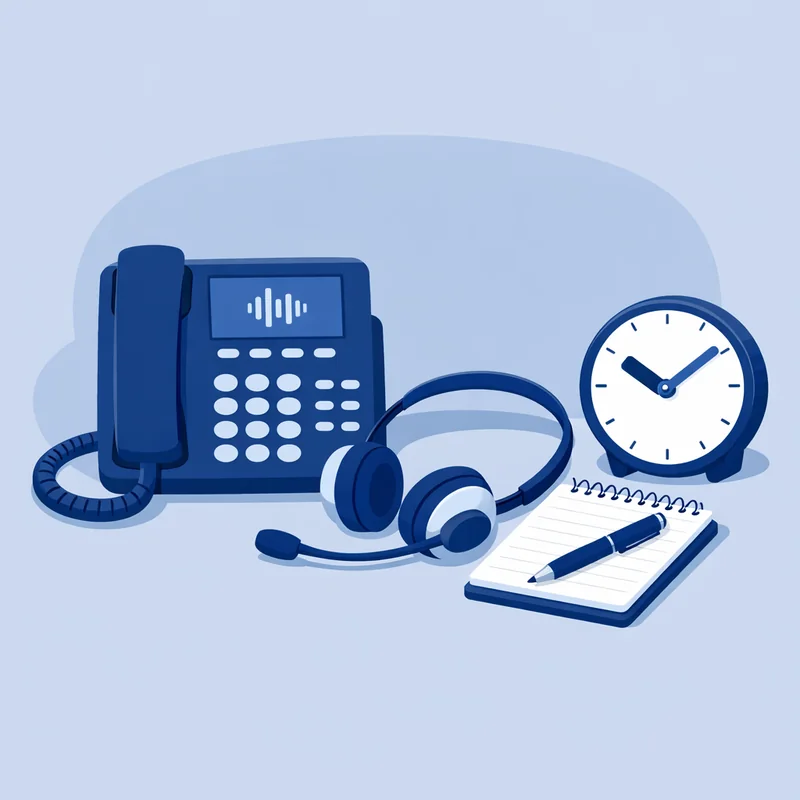
Telephone interpretation — also known as over-the-phone interpretation (OPI) — connects speakers of different languages through a three-way phone call with a professional interpreter. It is the fastest, most accessible form of interpretation service available, used millions of times daily across healthcare, legal, government, business, and emergency settings.
How Telephone Interpretation Works
The Basic Process
- You call the OPI provider's access number (or the provider calls in to your conference line)
- You enter your client code or account credentials
- You select the target language (by pressing a number or speaking the language name)
- An interpreter connects — typically within 30-60 seconds
- The interpreter facilitates the conversation between you and the limited-English-proficient (LEP) individual
- When done, you disconnect — billing is based on actual minutes used
Connection Methods
Dedicated access number: You dial a toll-free number provided by your OPI vendor. This is the most common method.
Dual handset phones: Healthcare and government facilities often use dual-handset phones where the patient/client and provider each have a handset, and the interpreter is on speaker or a third line.
Conference call: For ad hoc situations, you can add the interpreter to a standard conference call.
App-based connection: Many modern OPI providers offer smartphone apps that connect you to interpreters with one tap.
Interpretation Mode
Telephone interpretation uses consecutive interpretation: the speaker says a few sentences, pauses, and the interpreter renders the message in the other language. This back-and-forth continues throughout the conversation.
Unlike simultaneous interpretation (where the interpreter speaks at the same time as the speaker), consecutive interpretation over the phone works naturally because all parties share a single audio channel.
When to Use Telephone Interpretation
Ideal Situations
Emergency and urgent needs. When you need an interpreter immediately — in an emergency room, at a 911 dispatch center, at a police scene — OPI provides the fastest connection to a qualified interpreter.
Short interactions. For conversations lasting 5-15 minutes — a pharmacy consultation, a quick medical follow-up, a benefits eligibility call — OPI is the most cost-effective option.
Rare languages. For less common languages (Hmong, Tigrinya, Burmese, Pashto, Marshallese), finding an in-person interpreter may be impossible. OPI providers maintain networks of interpreters covering 200+ languages.
After-hours needs. When language needs arise outside business hours — nights, weekends, holidays — OPI services operate 24/7/365.
Rural and remote locations. In areas without local interpreter availability, OPI bridges the gap instantly.
Multiple languages in one day. A hospital that serves patients speaking dozens of different languages benefits from OPI's ability to connect to any language on demand.
When to Consider Alternatives
Lengthy proceedings. For all-day depositions, court hearings, or multi-hour medical consultations, in-person interpretation or VRI may be more practical and less fatiguing.
Highly visual content. When the conversation involves pointing to images, reviewing documents together, or demonstrating physical movements, video remote interpretation (VRI) or in-person interpretation is preferable.
Sensitive emotional situations. End-of-life discussions, mental health evaluations, and trauma interviews benefit from the physical presence and visual cues that in-person interpretation provides.
Sign language. ASL and other sign languages obviously cannot be interpreted over the phone. Use VRI or in-person interpretation.
Industries That Use OPI
Healthcare
Hospitals, clinics, pharmacies, and health insurance companies use OPI as their primary language access tool:
Patient intake and registration, Triage and emergency assessments, Medication counseling, Appointment scheduling, Discharge instructions, Insurance enrollment and benefits explanations, and Telehealth appointments (interpreter joins the call)
Legal
Law firms, courts, and law enforcement agencies use OPI for:
Initial client consultations, Miranda rights delivery, Witness statements, Probation check-ins, and Attorney-client calls (must be confidential and HIPAA/privilege-protected)
Government
Federal, state, and local government agencies use OPI to comply with Title VI of the Civil Rights Act:
Social services intake, Benefits applications (SNAP, Medicaid, TANF), Unemployment claims, Voter assistance, and Tax helplines
Insurance
Health, auto, homeowner's, and life insurance companies use OPI for:
Claims processing, Policy explanations, Coverage inquiries, and Dispute resolution
Financial Services
Banks, credit unions, and financial institutions use OPI for:
Account opening, Loan applications, Fraud investigations, and Customer service calls
Benefits of Telephone Interpretation
Speed
Average connection time to an interpreter is 30-60 seconds for common languages (Spanish, Mandarin, Vietnamese, Arabic) and 1-3 minutes for rare languages. No scheduling required.
Cost Efficiency
OPI charges by the minute, with no minimums in most cases. For a 5-minute call, you pay for 5 minutes. No travel costs, no minimum hourly booking, no cancellation fees.
Language Coverage
Major OPI providers cover 200-350+ languages. This breadth is impossible to match with in-person interpreter networks.
Availability
True 24/7/365 availability. Language access never closes.
Scalability
Whether you need 10 interpreted calls a month or 10,000, OPI scales instantly without additional infrastructure.
Confidentiality
The interpreter is a disembodied voice — they do not see the patient or client, do not know the location, and cannot identify anyone visually. This adds a layer of anonymity.
Challenges and Limitations
No Visual Cues
Without seeing facial expressions, gestures, or body language, the interpreter may miss non-verbal communication. The telephone-only format requires clear, deliberate speech from all parties.
Audio Quality
Poor phone connections, background noise, and speaker phone echo can degrade interpretation quality. Use a quiet room and a good phone whenever possible.
Interpreter Fatigue
Consecutive interpretation over the phone is cognitively demanding. For calls exceeding 30-45 minutes, interpreter accuracy may decline. Consider scheduling breaks or switching to a different modality for longer sessions.
Technology Dependence
OPI requires a working phone line. In technology failures, natural disasters, or power outages, phone-based interpretation may be unavailable.
How to Get the Best Results from OPI
Before the Call
Identify the language needed. Ask the LEP individual what language they speak (many OPI providers have language identification services).
Prepare key information. Have names, dates, account numbers, and key talking points ready.
Use a quiet room. Background noise is the number one quality issue in OPI.
During the Call
Speak directly to the person, not to the interpreter. Say "What is your date of birth?" not "Ask him what his date of birth is."
Use short sentences. Pause after every 1-2 sentences to let the interpreter translate.
Avoid jargon and idioms. Use plain language that translates clearly.
Spell out names, addresses, and numbers. Don't assume the interpreter caught them.
Speak at a normal pace. Don't shout or slow down artificially.
After the Call
- Document the interpretation. Note the date, time, language, and duration of the interpreted call.
- Provide feedback to your OPI vendor if there were quality issues.
OPI vs VRI vs In-Person Interpretation
| Feature | OPI | VRI | In-Person |
|---|---|---|---|
| Connection time | 30-60 seconds | 1-3 minutes | Hours to days (scheduled) |
| Visual communication | No | Yes | Yes |
| Cost per minute | $1-3 | $2-5 | $50-150/hour |
| Language coverage | 200-350+ | 50-100 | Limited by local availability |
| Equipment needed | Phone | Tablet/laptop + internet | None |
| Best for | Short, urgent calls | Visual needs, sign language | Long, complex sessions |
Choosing an OPI Provider
Key Factors
- Connection speed — How fast do interpreters connect?
- Language coverage — How many languages are available?
- Interpreter qualifications — Are interpreters certified or trained?
- Industry specialization — Do they have medical, legal, or technical interpreters?
- Per-minute rates — What is the cost structure?
- Minimum charges — Is there a per-call minimum?
- Reporting and analytics — Can you track usage by department, language, and duration?
- Compliance — HIPAA for healthcare, CJIS for law enforcement, etc.
Link Translations OPI Services
Link Translations provides professional over-the-phone interpretation in 200+ languages with rapid connection times. Our interpreters are trained in medical, legal, and business terminology.
24/7/365 availability, Average connection time under 60 seconds for top languages, Per-minute billing with no minimums, HIPAA-compliant for healthcare, Secure and confidential, and Dedicated account management
Contact us to set up telephone interpretation for your organization.