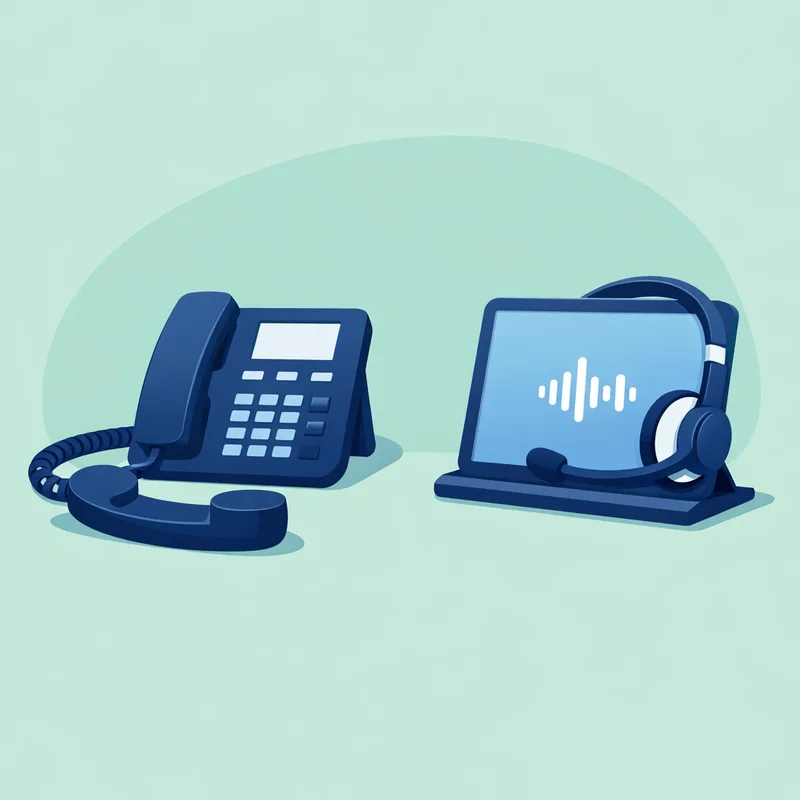
Video remote interpretation (VRI) and over-the-phone interpretation (OPI) are the two primary forms of remote interpretation. Both connect you to a professional interpreter instantly, but they work differently and serve different purposes. Choosing the right modality — or knowing when to use each — is essential for effective communication with limited English proficient (LEP) individuals.
The Core Difference
The fundamental difference is simple:
VRI — The interpreter is connected via video. They can see and hear both parties.
OPI — The interpreter is connected via audio only. They can hear but cannot see anyone.
This single difference — visual access — drives most of the advantages and limitations of each modality.
Side-by-Side Comparison
| Feature | VRI | OPI |
|---|---|---|
| Connection speed | 30-60 seconds | 15-45 seconds |
| Visual cues | Yes — facial expressions, gestures, environment | No |
| Equipment needed | Device with camera, screen, internet | Phone (landline or mobile) |
| Internet required | Yes (1-2+ Mbps) | No (works on any phone line) |
| Cost per minute | Higher ($1.50-$4.00) | Lower ($0.80-$3.50) |
| Best for duration | 5-45 minutes | 1-20 minutes |
| ASL/sign language | Yes | Not possible |
| Document review | Interpreter can see documents held up to camera | No |
| Patient/client comfort | Some discomfort with video | Generally more comfortable |
| 24/7 availability | Yes | Yes |
| Infrastructure investment | Moderate (tablets, carts, Wi-Fi) | Minimal (existing phones) |
| Reliability | Depends on internet quality | Very reliable (phone network) |
When VRI Wins
Medical Encounters
VRI excels in healthcare settings because visual information matters:
Physical assessments — The interpreter can see what the doctor is pointing to, observe the patient's pain responses, and understand physical demonstrations.
Informed consent — Patients sign consent forms during VRI sessions. The interpreter can see that the patient is nodding, looking confused, or hesitating — cues that are invisible over the phone.
Medication instructions — The interpreter can see the nurse holding up a medication bottle or demonstrating an injection technique.
Pediatric care — Children respond better to seeing a face on screen than hearing a disembodied voice on a phone.
Mental health — Therapists and counselors rely heavily on facial expressions, body language, and emotional cues. VRI preserves much of this non-verbal communication.
Sign Language Interpretation
VRI is the only remote option for American Sign Language (ASL) and other sign languages. OPI is inherently impossible for sign language interpretation since the interpreter must be able to see the Deaf individual signing.
The ADA requires that VRI for sign language meet specific technical standards: Real-time, full-motion video, High-resolution image showing interpreter's face, arms, hands, and fingers, Clear audio for the hearing party, and Adequate staff training
Complex Conversations
When conversations are nuanced, multi-layered, or emotionally charged, the visual connection of VRI improves communication quality:
- The interpreter can gauge comprehension from facial expressions
- Both parties feel more personally connected through video
- Misunderstandings are caught faster through visual cues
- The interpreter can see contextual clues (medical equipment, legal documents, the environment)
Document-Heavy Situations
While not a replacement for having documents translated, VRI allows the interpreter to see documents held up to the camera:
Forms being filled out, Prescription labels, Appointment cards, Discharge instructions, and Insurance cards
This helps the interpreter provide accurate context and catch errors in real time.
When OPI Wins
Speed and Simplicity
OPI requires nothing more than a phone. No apps to open, no cameras to position, no internet connection to troubleshoot. Pick up the phone, dial the number, and you're connected.
For staff who are less tech-savvy, OPI eliminates the technology barrier entirely.
Reliability
Phone networks are more reliable than internet connections. OPI works:
- During internet outages
- In areas with poor Wi-Fi coverage
- In basement offices or rooms without wireless signal
- On mobile phones in the field (law enforcement, social workers, home health nurses)
When your VRI freezes mid-conversation due to bandwidth issues, OPI is the reliable fallback.
Cost
OPI rates are consistently lower than VRI rates. For organizations conducting thousands of interpretation sessions per month, the per-minute savings add up significantly:
- A hospital using 5,000 minutes/month at $1.25/minute (OPI) vs. $2.50/minute (VRI) saves $6,250 monthly
- For short interactions (under 5 minutes), VRI's higher per-minute cost is harder to justify
Privacy and Comfort
Some individuals are uncomfortable being on camera, particularly in sensitive situations:
Domestic violence discussions, Substance abuse counseling, STD/STI testing and results, Homelessness services intake, and Undocumented immigration concerns
OPI provides a layer of anonymity that can make LEP individuals more willing to share sensitive information.
Phone-Based Interactions
When the conversation is already happening by phone, OPI is the natural choice:
Call center customer service, Insurance claims by phone, Benefits enrollment calls, Appointment scheduling, Follow-up calls from medical offices, and Debt collection calls (with language access requirements)
Adding VRI to a phone call would require switching platforms, which adds complexity and time.
Field Work
Professionals working outside the office need OPI:
Law enforcement officers on patrol, Social workers making home visits, Home health nurses, Building inspectors, Census workers, and Emergency responders
These professionals carry phones, not VRI carts. OPI puts an interpreter in their pocket.
The Hybrid Approach: Using Both
Most organizations benefit from having both VRI and OPI available. The key is matching the modality to the situation.
Recommended VRI Scenarios
Hospital bedside consultations (over 10 minutes), Mental health and behavioral health sessions, Informed consent discussions, Complex medical procedures and explanations, Sign language interpretation, Attorney-client meetings, IEP meetings in schools, and Intake assessments for social services
Recommended OPI Scenarios
Emergency room triage (first contact), Appointment scheduling, Prescription refill calls, Quick status updates, Phone-based customer service, Field encounters (law enforcement, home health), After-hours calls, and VRI backup when internet is unavailable
Creating a Decision Framework
Train your staff with a simple decision tree:
- Is the person Deaf or hard of hearing? → VRI (required for sign language)
- Is the conversation by phone? → OPI
- Is there no internet/video capability? → OPI
- Is the encounter under 5 minutes? → OPI (more efficient)
- Is the conversation sensitive/complex/medical/legal? → VRI
- Is the conversation over 15 minutes? → VRI (visual engagement reduces fatigue)
- Default for everything else → Your organization's preference based on cost and infrastructure
Technology Convergence
Modern interpretation platforms increasingly combine VRI and OPI in a single system:
One platform, two modalities — Staff open the same app for both VRI and OPI
Seamless switching — Start on video, switch to audio if bandwidth drops
Unified billing — One invoice covers both services
Single reporting dashboard — Track all interpretation usage in one place
Consistent interpreter pool — The same interpreters serve both VRI and OPI
This convergence simplifies procurement, training, and management.
Making the Business Case
For VRI
Improved patient/client outcomes through better communication, Reduced readmission rates (healthcare), Better compliance with ADA, Section 1557, Title VI, Higher patient satisfaction scores (HCAHPS), Reduced liability from miscommunication, and Ability to serve Deaf and hard-of-hearing individuals
For OPI
Lower per-minute cost, Faster implementation (no equipment to deploy), Minimal training required, Works anywhere with phone service, Scales easily to new locations, and Reliable backup when VRI fails
For Both
Complete language access coverage for all situations, Flexibility to match the right modality to each encounter, Compliance with all federal and state language access requirements, and Better staff satisfaction (right tool for the right job)
Link Translations Remote Interpretation Services
Link Translations provides both VRI and OPI services through a unified platform:
- 200+ languages available
- On-demand connection in under 60 seconds
- 24/7/365 availability
- HIPAA-compliant video platform
- Per-minute billing with volume discounts
- No minimum session requirements
- Seamless switching between VRI and OPI
- Dedicated account support and training
- Get a free quote to learn which solution fits your organization